Hello there, I am Callum Rivett, and welcome to this instalment of my
articles. Today, I will be looking at a subject close to a number of
footballer’s hearts: the mental side of the game.
One hears many a
manager saying the game is “played in the mind” and some may wonder what
that means. It is one of the reasons that there are upsets. The reason
why teams are able to win games that perhaps they shouldn’t. They either
had a fantastic game plan, or they were prepared enough mentally to go
out and challenge. The opposition (let’s call them Champions) may well
go into the game against the Underdogs thinking they will be 3-0 up by
half-time and it’s an easy three points.
However, if the Underdogs
come out and attack, it puts the Champions mindset under threat. This
isn’t the team they were expecting. They thought they would be able to
stroll to an easy victory. The Champions were not adequately prepared
mentally. The Underdogs set up to frustrate and annoy the Champions, get
stuck in, and subsequently win the game.
That was purely a figment
of imagination, but it happens every week. Norwich 1, Arsenal 0 last
week. Middlesbrough 4, Manchester United 1 in 2005. The list goes on.
These are just notable examples I can drag up from my memory banks.
There is also a mental side to the game that the supporters and media do not see. The side of depression.
Dean Windass and Darren Eadie are just two ex-pros who admitted that
they were suffering from depression after leaving football, and in my
opinion it is easy to see how it can happen. You grow up with football:
football is your childhood, as it is mine. You don’t know anything other
than kicking a ball around grass into a net. Your whole mental mindset
is being focussed on the weekend, on the next game. That is what your
week builds up to as a professional footballer.
When I step onto
the football pitch, I become a different person. Every thing bad that
has happened in the week is forgotten when you cross that white line in
the grass, when that first whistle blows. You are absorbed in the game,
you and it are one. Every kick, every goal: you feel it. You feel the
emotion running through you, and you love it, you crave it.
When it
is taken away - either through retirement or injury - you lose a part
of yourself. You lose the part that everyone knew, that everyone saw.
Your whole life hinged on playing football, then it’s gone.
Nothing
can match the thrill of adrenaline that football provides, it is
unique. It doesn’t require the type of courage that throwing yourself
out of a plane does. It isn’t the bravery of saving a life. It’s
something entirely different, yet entirely simple.
Football fills you with a determination: I will win that header, I will make that tackle.
Football relieves stress. Whilst exercising, neurotransmitters are
stimulated, and these are responsible for producing sensations such as
happiness, or the feeling of stress relief. Endorphins are produced,
which target the limbic and prefrontal areas of the brain; the areas
associated with emotions and feelings. Footballers run many kilometres a
game in total, and these endorphins produce a phenomenon called
“runner’s high”.
But endorphins are also related to addiction. Drug
addicts have been shown to have high levels of endorphins, according to a
paper published by the neuroscience journal Impulse.
What that
means is that football is a drug. It is an addiction, and when it is
taken away, players often feel low, depressed. Watching a game live does
not quite replicate the feeling that playing does, so offers only a
temporary reprieve. Footballers may have to make do with coaching, but
sometimes - in the sad case of Gary Speed - it is not enough.
On a
different approach, injury can also cause depression. Injury is a lonely
place: your fellow professionals are outside, kicking the ball around,
whilst you are stuck in the gym trying frantically to build up your
muscles and match fitness. Depression can hit even the player with the
strongest mind.
To conclude, more support needs to be given to
players who have retired and are struggling, or are out injured for long
periods of time. Whether they are in the Ridgeons Premier or in the
Premier League, there needs to be support give by the PFA. Depression
can affect everybody, and the best possible support needs to be given to
those suffering from it, either in football or someone from everyday
life.
Follow Callum on twitter: @CJRivett12. You can find more of Callum's work here.

Showing posts with label Callum Rivett. Show all posts
Showing posts with label Callum Rivett. Show all posts
Monday, 29 October 2012

Monday, 10 September 2012
My Football Journey
Hello, I’m Callum Rivett, and this week I’ll be
giving you a snippet of my footballing ‘career’. It’s something
different for you, and hopefully it’ll give you a chance for you to know
me a bit better. If you want to list your favourite moments of your
footballing journey, you are more than welcome to do so in the comments
below! (And if you’re a scout for any football club, I’m more than
welcome to receive an offer…)
I
started playing competitive football when I was 5, playing a year up
for Hemsby Hornets, as a right back, purely because there wasn't a team
in my age group yet. I played a few years there, then a team formed that
was my age group so I went there and continued as a right back. We were
constantly near the bottom of Division One (the top league of a three
tiered system) but did win the Shield (the Carling Cup of the Norfolk
and Suffolk Youth League) once, then got relegated.
They
folded and our manager went in 2008 - and took most of our players,
including myself - to Caister Roma who had just been promoted to
Division One. In my first year there we finished 2nd in the league. I
was still right back, then I went to right midfield and often central
midfield. I preferred playing on the wing. The second year was terrible
for me: the manager didn't rotate - myself and two others found
ourselves on the bench every single week. We finished 5th that year.
In
the next preseason I scored a really good goal against a team in the
year above: I got the ball inside my own half, flicked it up to our
striker in the centre circle, he headed it back to me and I hit it on
the half-volley from inside the centre circle and lobbed the keeper. But
once again I was constantly on the bench, and was getting annoyed. I
frequently scored and assisted from the midfield. That year (2009-10)
was my last year at Caister, as they folded.
I
joined a Division Two (the leagues had been compressed, so now there was
only two divisions) side where all my mates played but finished near
the bottom of the league a lot of the time. This was my first ever year
upfront, and in my first game against one of the best teams in the
league I scored a hat-trick. I went on to score 31 goals in 21 games,
which is ok. We finished 9th out of 12.
Then
last year we got a load of new, good players who were our mates, and we
really improved. I scored 36 goals in 22 games then, we finished 3rd,
just outside the promotion places. We got to the semi-finals of the
Shield, but got knocked out by a poor refereeing decisions - it was 1-1
away to a Division One side, and in the last few minutes one of their
players dived in our box and somehow the ref thought it was a penalty.
They scored it, and we lost 2-1.
But we always
struggled getting a full team each week despite having fourteen players
signed on. The deadline for getting a team for this coming season is
today [Saturday 8th], and currently only nine players have signed on, so
it's looking doubtful we'll have a team.
Follow Callum on twitter: @CJRivett12. You can find more of Callum's work here.
Saturday, 21 July 2012
Interview with a pro James Panayi – ex Watford, Apollon FC defender and QPR trailist
Hello, I'm Callum Rivett and this week for The Football Front, I'm doing something a
little different. I've gotten myself an interview with an ex-pro -- James
Panayi. He's my PE teacher, a very good one at that, and he kindly agreed to do
this interview, so I thought I'd share it with you. It actually made me more
aware of his footballing talents - he clearly was a good player. Also, it made
me realise how much he had been through to "nearly make it" as he put
it. From Luton Town's
youth academy to astonishing racism in Cyprus,
this is James Panayi.

Q: How long did your pro career span?
A: I first started with Luton
Town, when I was 13 years old, for
one season, in the academy. I then trained for Charlton for a year, and when I
was 15 I was offered a trail with Watford, which
resulted in myself being offered a two-year school boy contract, like an
apprentiship, in 1996 to 1998 on £45 per week. I was offered a pro contract,
originally a two-year but upped to four, on £300 per week. I spent one year as
a pro in the reserves. Then in 1999, I made my debut for the first team versus
Coventry at Highfield Road, which was live on Sky’s Super Sunday, so that was
pretty exciting. I played the next game as well, at Hillsborough against Sheffield
Wednesday, but was then dropped meaning I missed the game against Newcastle
where I would have had to mark Alan Shearer, who at that time was one of
Europe’s hottest marksmen, so I was gutted. I was injured over Christmas, and
didn’t play the rest of the season and had to have two operations on my
shoulder. The next year in the Championship [then Division One] - so against Coventry
and Wednesday was in the Premiership - I played eleven games. The stand-out
game being a 4-1 win over Norwich City.
I was offered a two-year contract, which I first turned down, then the
management changed. It used to be Graham Tayler, ex-England manager, but he was
retiring so it turned to Gianluca Vialli. I went and played on the pre-season
tour, but fell out of favour, then I wasn’t offered a new deal, so I left when
my contract expired and had a trial at QPR. I played against Celtic in a
friendly infront of a packed Loftus Road,
so that was good. I wasn’t offered a contract, and when I was considering
hanging up my boots and stopping, there was a last-minute offer from Cypriot
side Apollon Limassol. They had tax-free pay but a different wage structure, so
I didn’t get paid for two or three months. I didn’t realise, but they were a
right-wing club, in terms of politics, and the first game was versus a
left-wing team [AC Omonia] and I looked around the ground and there were
banners of swastikas, and loads of flares. I will say that I was put off a bit
by it, and when I was paid, I went home and studied a journalism course for two
months. I got pieces published on Football365’s website, then did some
coaching. I decided that I wanted to go to university, so in summer 2003, I
did, and now, well, I’m PE teacher at Flegg
High School. But now I try to avoid
playing, and I'll only play if it's for fun.
Q: Who was the best player you played either with or
against?
A: Against, there were a few good players, but it has to be
Rio Ferdinand. I played against him when he was in the West Ham youth team, he
was 17 I think, and he’d already made his debut in the first team. He was an
absolute Rolls-Royce, and West Ham has one of the best youth set-ups in the
world, we never beat them. We beat teams like Man United, Arsenal, but we never
beat West Ham. With, it is probably Charlie Miller, who signed from Rangers. He
was the worst pro, an absolute disgrace – a borderline alcoholic, massive
gambler, but the best player.
Q: What was your biggest regret?
A: Not appreciating what I had at the time. Not working hard
enough. I almost became the stereotype, moan if we had double session, moan if
we didn’t have a day off, moan if we had fitness training. Players worse than
me have got further than me, some of my mates are millionaires. Am I bitter?
Nah, I just didn’t try hard enough.
Q: Best moment in your career?
A: There was a few. I’m a big Tottenham fan, so playing in
the reserves against them at White Hart Line has to be up there. But my debut
at Highfield was amazing – it was a mix of cacking your pants and excitement.
Q: Who was the joker in the dressing room?
A: Me, wasn’t it? (laughs) Nah, Charlie Miller was funny,
Noel Williams – he was a funny, funny guy. If you got him, he would not stop
until he got you back, and got you back hard. Briefly there was Ian Holloway,
he was a good character and a funny guy.
Q: If you could sum up your career in one word, what would
it be?
A: Crikey. Probably ‘nearly’. I was nearly there, but didn’t
work hard enough.
Friday, 6 July 2012
Euro 2012 Team Reviews
Hello, I’m
Callum Rivett, and this will be my review of the European Championship, running
through team-by-team. I’ll give a brief overview of their matches, then their
highlight. Finally a rating out of 10, based on what people thought of them
before the tournament (for example, a team who over-performed and came 2nd in
their group would get a higher rating than one who was expected to win their
group and did), and we’ll see if we agree. Hope you enjoy!


GROUP A
Poland
The hosts
were widely expected to qualify in second place from Group A, but they failed
to win a single game. Opening with a draw against Greece,
then another against Russia,
all they needed to do was beat an average Czech
Republic side. They lost 1-0, and the
co-hosts were out at the first hurdle, but at least there was one moment to
savour: Lewandowski’s strike against Russia
was easily their highlight.
RATING: 5/10
Greece
The 2004
winners were not expected to proceed from their group, with Russia
and Poland the
favourites. However, a draw against Poland
and an unlikely win against Russia
- which was their highlight - in the final group match sent them through,
playing their almost traditional style of play: defensive. Finishing second, they
faced a tough task against Germany
in the quarter-finals, and succumbed to a 4-2 loss. Not disgraced, and can take
heart from their performances.
RATING: 7/10
Russia
This was a
Russian side full of quality, boasting players like Alan Dzagoev, Roman
Pavlyuchenko and Andrei Arshavin. Things started very well for them, a
resounding 4-1 victory over a lacklustre Czech
Republic side, their one and only
highlight. A draw against Poland
meant they were still favourites to progress, and only a defeat to Greece
and a Czech Republic
win over Poland
in the final group game would send them out… A 1-0 defeat to Greece
followed, and the Czechs won 1-0, sending the Russians home early.
RATING: 4/10
Czech Republic
The Czechs
were expected to go out with the Greeks in the group stage, but veteran Milan
Baroš helped guide them to the last 16, exceeding many expectations. A heavy
defeat to Russia
in the opening game merely spurred them on, collecting two wins from two
against Greece
then Poland.
They met Portugal
in the quarters, and went out fighting, going down 1-0. Perhaps not the most
vintage set of performances, but it’s the results that matter. The win over Poland
has to be the highlight.
RATING: 7/10
GROUP B
Holland
The World
Cup runners-up had a nightmare tournament, one that fans hope can be thrown
into the abyss of football history, never to return. Expectations were high,
but performances and results never met those standards. Wesley Sneider hinted
at an “ego problem” within the Dutch set-up, and with players like Arjen
Robben, you can’t help but to agree. Losing every game and not putting up much
of a fight dents their reputation, one which they hope will be restored come
Brazil 2014.
RATING: 2/10
Denmark
Being dealt
in the Group of Death meant expectations were low, and the world was expecting
them to be on the first flight home with zero points. But an opening win over Holland
- their highlight - put them in good spirits, and it took a late Portugal
winner to deny them a point. Germany
followed, and so did another good display, but they unfortunately lost 2-1,
sending them home with the Dutch.
RATING: 7/10
Germany
One of the
best German sides in my lifetime, and they were hailed as the favourites to
lift the trophy before it had even kicked off. Three wins out of three in the
group stage certainly helped their cause, and momentum was building. A 4-2 win
over Greece and
they were in the semi-finals, thinking they could go all the way. But the
infamous Mario Balotelli popped out with two goals to ruin the Germany
parade.
RATING: 8/10
Portugal
A team that
has constantly underperformed given the strength of their side on paper:
Ronaldo, Nani, Moutinho, Miereles… Finally they get to where they should be - a
semi-final, and just penalty kicks away from a final. Going out to the eventual
winners is no disgrace, and they put in some good performances along the way,
and finally got Ronaldo playing well for the national side.
RATING: 8/10
GROUP C
Spain
Three
trophies on the bounce says it all about this Spain
side. They are simply the best in the world. Why would anyone ever call them
boring? They play nice football, and have when their original tactic was on the
verge of being sussed out, they changed it to a tactic no one expected. They
didn’t play with a striker, yet they still had a striker win the Golden Boot.
It seemed they didn’t get out of second gear for most of the tournament, until
the final. The performances weren’t vintage Spain,
but it’s the results that will be remembered.
RATING: 10/10
Italy
The other
finalists surprised many on-route, including beating favourites Germany.
Even more surprising was Mario Balotelli. He stormed his way to three goals,
including a brace against the Germans in the semi-final. The cool and calm
Andrea Pirlo provided the killer ball many times, and his style and grace on
the football pitch will be missed at international tournaments, as this was
almost certainly his last one. A win over England
on penalties was impressive, but they had many chances to kill us off. It has
to be remembered that Thiago Motta had to go off injured in the final, and they
didn’t deserve to lose so heavily.
RATING: 9/10
Ireland
A
disastrous tournament in terms of results for the Irish, but the fact that they
even reached the group stages has to be seen as a success. The fans were
brilliant, but that would be no consolation back in Ireland
as they crashed out at the first hurdle. They gave it their best shot, but with
teams like Spain,
Italy and Croatia
in their group no one expected them to do anything, and they didn’t.
RATING: 3/10
Croatia
Croatia
were unlucky to be drawn in this group, they had a good side and a draw against
Spain would
have sent them through. Slaven Bilic had them playing well, and scoring goals.
They didn’t have the strongest defence, but with a bit more coaching, and with
the youngsters coming through, they could be a force to be reckoned with in the
next World Cup. A draw against Italy
and a convincing win over Ireland
made it a very respectable campaign, and a good building block.
RATING: 6/10
GROUP D
Ukraine
The
co-hosts didn’t embarrass themselves in a tough group, with an opening victory
over Sweden the
highlight. After falling behind, they rallied and the home crowd spurred them
onto a well-deserved win. An expected defeat against France
followed, then a spirited performance against England
where they had a goal disallowed - it did cross the line, but the attacker was
offside so justice was done in my view. They played well excluding the France
game, and it was a good tournament.
RATING: 6/10
Sweden
They lost
in surprising fashion against Ukraine,
then a good performance - helped by England’s
defensive frailties - was only ruined by a sublime back-heel by Danny Welbeck
and a wicked shot on the edge of the area by Theo Walcott. They were not sent
home empty handed, however, defeating France
2-0 in the final group game, an acrobatic Zlatan Ibrahimovic volley giving them
the lead, then a late goal secured the victory. Not a terrible performance, but
the opening day loss will haunt them.
RATING: 6/10
France
A balanced
opening game against England
ended in a 1-1 draw, then a victory against Ukraine
provided a massive stepping stone to qualifying for the quarter finals. But a
loss to Sweden
in the final group game proved their downfall, which meant they finished second
in the group behind England.
They faced eventual winners Spain,
and got dominated. For a French side with so much quality - easily a better
side on paper than England’s
- they lacked the cutting edge, and this will be a tournament to forget.
RATING: 5/10
England
Last but by
no means least, we come to England.
A team in transition, with a newly appointed manager meant expectations were
low. Some expected us to go out in the group, most thought a quarter final was
a reasonable target. We, along with Spain,
were unbeaten in the first ninety minutes of football, and only went out by the
dreaded penalties. This was undoubtedly a tournament where not much was known
about our game plan, our manager, but we put in a good display. Hopefully we
will be ready for Brazil 2014, and get further than the quarters, where we fall
so many times.
RATING: 7/10
So, that wraps up the team reviews, and as you can tell this
took a while: re-watching highlights, looking at team line-ups, tactics,
results. If you agree or disagree, I’d be delighted to know, so drop me a line
either on my twitter (@cjrivett12) or in the comments below. Hope you enjoyed,
and I’d like to end on a quote which I found completely correct, one by double
European Championship and World Cup winner Cesc Fabregas:
“Those people who think we are playing boring, in my opinion
they don’t understand the game.”
Follow Callum on twitter: @CJRivett12. You can find more of Callum's work here.
Sunday, 24 June 2012
England and Italy… Rooney and Balotelli
Hello, I’m Callum Rivett, and welcome to my latest blog for
The Football Front. This week it's the turn of the quarter finals to capture my
fleeting glances, and what a quarter final it looks to be.
England.
Who thought
England would
finish top of the group with two wins and a draw against France?
I certainly didn’t, and I think this is because the expectations had been
lowered to the point that we thought we may not even get out of the group.
We have
avoided world champions Spain,
which is welcome news to every English fan, but unfortunately face a tie with
favourites Germany
in the semi-final if we beat Italy.
The Germans are, unsurprisingly, an efficient bunch, and have proved so by
winning four out of four matches. Their only weakness could be their defence -
an average Greek side scored two, albeit one from a penalty.
Roy Hodgson
has built up a fantastic team spirit within the camp, and that can only have a
positive effect. The Italians are nothing special, but then neither are we.
Both sides are defensively minded, and will sit back and look to hit the
opposition on the counter.
Those
techniques are fine against opposition that like to attack and are a better
side than yourself. But what we could be looking at is a match where the two
sides are waiting for the other to attack, both sitting back, both scared of
going forwards.
Then again,
since it’s a quarter final and winner-takes-all match, we could have the most
exciting and enthralling match of the tournament on our hands. Two very evenly
matched sides, no big expectations, but with a team full of hard-working,
classy players. We have Rooney; they have Balotelli. We have Hart; they have
Buffon.

Both us and
Italy boast
world-class talents, but both have a loose fuse. Rooney and Balotelli can be
either heroes or villains. Both have been sent off numerous times, but they
have both scored numerous times. Balotelli is effectively the Italian Wayne
Rooney. You can see the raw talent, the enthusiasm, but there is something
else, something dark. A violent, idiotic side: Rooney’s kick against Montenegro,
Balotelli’s sending off versus Arsenal, Rooney’s stamp on Carvalho, Balotelli
and the bib.
Ultimately
Balotelli is more idiotic than aggressive, and Rooney vice versa, but the
talent there is undeniable. Under the guidance of Roberto Mancini, Super Mario
can flourish to become a world-class talent, but only if Man City can control
his wild side. He’s arrogant, but not in a moronic way. He gives 60% of his wages
to charity, so it is obvious he is actually not as stupid as he makes
out.
There is
only one word that fully describes Mario Balotelli: entertaining.
These two
will be the focal points for the media come Sunday, and they could hold the key
to their country’s success. England
will have to dominate Italy’s
defence - which is weak - to win, and I believe that if we get to half-time at
0-0 then we have a superb chance to get to a semi-final, something that doesn’t
come along that often. In fact, I wasn’t even born when England
last got to the semis, but I know the story of that 1990 game against Germany.
Gazza’s tears, Pearce’s penalty, Lineker’s 80th minute equaliser…
We have a
real chance of making a semi-final. We are on the same level as Italy,
and it should be a balanced match which whets the neutrals appetite, and drives
both country’s supporters to the brink of despair and back again.
It’s tiring
being an England
fan: the heart-aches, the quarter final exits, the constant
underachievement.
But now
it’s different. Now there are no expectations. The nation believes, not expects.
Follow Callum on twitter: @CJRivett12. You can find more of Callum's work here.
Monday, 18 June 2012
What have we learnt so far in Euro 2012?
I’m
Callum Rivett, and this week I’m reflecting on the current situation in
the Euros. Twists and turns galore, we can expect plenty more exciting,
intriguing and defensive football - and that’s just England! The Group
of Death has lived up to its name, with no team guaranteed to go through
approaching the last game of the group stage. A draw would send England
through, Greece and the Czechs are in the last 16, Ireland and Sweden
are out and in the remaining groups no one has already qualified. Should
be an exciting round three then!
Spain need to be more direct
Everyone
knows that Spain play some of the most attractive football on the
planet (along with Barcelona) but sometimes lack the cutting edge. They
have the tools needed with Torres, Llorente, Negredo and any midfielders
they have, yet fail to utilise them enough. Spain pass the ball all the
way up to the opposition box, pass it some more, then when they finally
have the chance to shoot… they pass again. They try and walk the ball
into the net. With the quality they have in midfield, there can be no
harm in having a shot from outside the box once in a while. Iniesta,
Xavi, Fabregas, Silva, we’ve seen them smash a few into the top corner
before - why not have another go at it?
England have a real chance (only if we sort out our defence)

A
draw against the best team in our group goes a long way to help us go
far in this tournament, and the comeback victory over Sweden will
certainly boost morale. We have Carroll and Welbeck who are now scoring,
and Rooney is about to come back. Our squad is filled with youth with a
sprinkling of experience, and only two players are arguably world-class
-- Hart and Rooney. I’d say Hart is the most vital, he’s made quality
saves throughout the qualifiers and the tournament, most notably from
France’s Alou Diarra in the opening match. We would miss Hart so much if
we didn’t have him.
Germany are a force to be reckoned with
I
predicted Germany to win the Euros not that long ago, and they look
well on their way to fulfilling that prediction. A 1-0 win over Portugal
then a 2-1 win against Holland that never really looked in doubt means
they are sitting pretty, top of their group and it would take a shock
Denmark win over the Germans and a Portugal win over the Dutch to send
them home. To think that a talent like Mario Gotze is sitting on the
bench is astonishing, and you can really see the strength in depth they
have. Experienced veteran Miroslav Klose can come on if they are in need
of a goal, and that is not a bad sub to make! I’m sticking with Germany
to win it, they seem unstoppable at the moment.
Expect more shocks
Denmark
1 Holland 0. Russia and Poland being knocked out. Croatia snatching a
draw against Italy. England winners? It could happen. All we know is
that there will be plenty more shocks, upsets and early trips home for
some. Ireland might even support England, but then again we have more
chance of winning the Euros than them supporting us. Russia and Holland are already gone, which I’m shocked at, and so are
Poland. One of Italy, Croatia and Spain are going out, , expect the unexpected. You never know in this game.
Follow Callum on twitter: @CJRivett12. You can find more of Callum's work here.
Friday, 25 May 2012
The Top 5 Transfer Targets
Welcome to my blog, I’m Callum Rivett and this week I’ll be writing
about the top five transfer targets this summer and why they are being raved
about so much. Even though it's just finished, I can't wait for the Premier
League to start up again, and also can't wait for the Euros - we won't win but
watching teams like Germany, Spain and the Netherlands will be a joy for all. I
hope you enjoy this along with all my other work and spread the word about this
website and myself!
5 - Jordan Rhodes
This twenty-two year old is being touted as the next big thing from the lower leagues, being the top-scorer at all levels in English football this year with thirty-six league goals. He was also the first Huddersfield player to score back-to-back hat-tricks since the 1920s, against Exeter then Preston respectively. Teams such as Fulham and Norwich are rumoured to be interested in Rhodes, and I’m sure he can, and will, make the step up.
5 - Jordan Rhodes
This twenty-two year old is being touted as the next big thing from the lower leagues, being the top-scorer at all levels in English football this year with thirty-six league goals. He was also the first Huddersfield player to score back-to-back hat-tricks since the 1920s, against Exeter then Preston respectively. Teams such as Fulham and Norwich are rumoured to be interested in Rhodes, and I’m sure he can, and will, make the step up.
4 - Luka Modric
Once again, Modric is likely to be linked with numerous over the summer, with Real Madrid already rumoured to be ready to make a bid for the twenty-six year old. He is still a relatively young player, who’s just about to hit his prime, and this may convince teams to bid for him. I’m sure Chelsea will rekindle their interest in Modric, with a rebuilding job on the cards at Stamford Bridge. With Tottenham’s failure to reach the Champions League, his final decision may be swayed by this factor.
3 - Lucas Moura
Anyone who, like myself, plays Football Manager 2012 will know Moura for his five star potential and the fact he’s the best young player on the game. Chelsea have already had a £32.5m bid for him turned down, and I wouldn’t expect Sao Paulo to accept anything less than £40m for this nineteen year old. He has already played fifty-four games for the Brazilian First Division side, and with thirteen goals from the attacking midfield position, and this is sure to attract attention. And eleven caps for the Brazilian first team isn’t bad either.
2 - Mats Hummels
This twenty-three year old centre back has been attracting the attention of Arsenal, and they are keen to join Hummels with his German counterpart Per Mertesacker. Standing tall at 191cm (6ft 2), this monster is very unlikely to be beaten in the air, but also has a bit of pace about him so is unable to be beaten in a straight sprint easily, unlike Mertesacker. Borussia Dortmund’s centre back pairing of Hummels and Neven Subotic meant they only conceded twenty-five goals all season and secured the title and also the DFB-Pokal - the German equivalent of the English FA Cup.
1 - Eden Hazard

This Belgian superstar has wowed Ligue Un these past few years, the twenty-one year old scoring thirty-six goals in one hundred and fourty-seven appearances since 2007 from the left wing. Chelsea, Man United and Man City have all agreed terms with Hazard, and the footballing word will be awaiting his press conference or interview after the England-Belgium game which is when he will declare where he will be playing next year. £35m is considered to be the price they have offered to pay for his services, and it is a certainty that we will see him grace the Premier League next year, which will be a delight!
Follow Callum on twitter: @CJRivett12. You can find more of Callum's work here.
Saturday, 12 May 2012
The Football Front Awards
Hello there, I’m Callum Rivett and this week for The Football Front, I’m going to be giving my very special and virtually unknown (because I’ve just made them up) awards to various people and moments that have happened over the course of this entertaining season.
With the season nearly complete, the title is going to Manchester.
But to which club? Red or blue? In my eyes, it has to go to City. They face a
weak QPR side at home, where City have been magnificent this season, with a win
guaranteeing them the title. United play Sunderland away
- who are in bad form - so should win, but it will not matter unless City drop
points at the Etihad on Sunday. So, on with the awards!
Surprise Package Team of the Season
Winner: Newcastle
United
Runner up: Norwich
City. Third: Swansea
City.
This goes to the club who have performed the best over the season., against all
odds. This Newcastle side have
proved the pundits wrong all year long: tipped for relegation at the start of
the year, now fighting for a Champions League spot. The race for fourth - and
arguably third - goes down to the final day of the season, and this is in no
doubt a fantastic season for the Geordies. Norwich have to be ahead of Swansea
because they have the youngest squad in the Premier League and were the first
team in the top flight since 1999 to field an all-British starting line-up.
Player of the Season

Winner: Robin van Persie
Runner up: Joe Hart. Third: Antonio Valencia
There is no doubt about it, van Persie has easily been the best player this
season. Thirty goals in thirty-six Premier League games make him top scorer,
and he should win the Golden Boot unless there is a remarkable goal-scoring
feat committed by Wayne Rooney on the final day of the season. Joe Hart has
been one of Man City’s
unsung heroes this year, along with Vincent Kompany, keeping sixteen clean
sheets. Valencia
has fourteen assists and has been a vital asset for United this year in their
rather unsuccessful season.
Game of the Season

Winner: Man United 1-6 Man City
Runner up: Man United 8-2 Arsenal. Third: Wolves 1-5 West
Brom.
The noisy neighbours got even noisier by hammering their arch-rivals 1-6 on
their own turf. Old Trafford was stunned as the Citizens smashed six past the
Red Devils, with goals from Aguero, Silva, and braces from Balotelli and Dzeko
ensured United suffered their worst defeat at Old Trafford since February 1955.
Manager of the Season
Winner: Alan Pardew
Runner up: Paul Lambert. Third: Roberto Mancini and Brendan
Rodgers
Not surprisingly, the manager of the season order links up with the team of the
season order. Newcastle’s Alan
Pardew has been the mastermind behind the Magpies success this season, guiding
them to a battle for fourth spot. They will definitely get the Europa League
spot, so it should be interesting and exciting to see them in Europe
next year. Lambert once again beat Rodgers to second, because he had less
money, and Norwich have been
underrated this year. Norwich have
been the best promoted team this year, beating Swansea
and QPR home and away.
Manager of the Season
Winner: Alan Pardew
Runner up: Paul Lambert. Third: Roberto Mancini and Brendan
Rodgers
Not surprisingly, the manager of the season order links up with the team of the
season order. Newcastle’s Alan Pardew
has been the mastermind behind the Magpies success this season, guiding them to
a battle for fourth spot. They will definitely get the Europa League spot, so
it should be interesting and exciting to see them in Europe
next year. Lambert once again beat Rodgers to second, because he had less
money, and Norwich have been
underrated this year. Norwich have
been the best promoted team this year, beating Swansea
and QPR home and away.
Signing of the Season

Winner: Sergio Aguero
Runner up: Demba Ba. Third: Mikel Arteta
Sergio Aguero’s twenty-two goals in thirty appearances for Man
City this year have certainly
helped City win the title. He seems a bargain at £35m compared to some other
signings. To think Liverpool could have signed this star
for just £35m more than Andy Carroll is astonishing, they really missed a trick
there. Demba Ba has had a fantastic season for Newcastle,
helping them to a top five finish. Arteta has been outstanding for Arsenal this
season, and their recent drop in form can be coincided with the loss of Arteta
through injury, so the sooner him and Wilshere return, the better for Arsenal
fans.
Impact Signing of the Season
Winner: Papiss Demba Cissé
Runner up: Nikica Jelavic. Third: Stephen Pienaar
Papiss Cissé has taken the league by storm since signing from German outfit SC
Freiburg in January for a fee of around £10m. He has scored thirteen goals in
thirteen appearances so far for Newcastle,
becoming an instant fan favourite at the Sports Direct Arena. But the two
Everton signings make it into the top three, Nikica Jelavic has also made an
instant impact to Everton, scoring eight goals in twelve games, helping them
finish above Merseyside rivals Liverpool. Third was a
tight call between Pavel Pogrebnyak and Stephen Pienaar, but it has to go to
the South African. His return to Everton, albeit only on loan, has sparked
Everton’s season into life. The performance he put in against Chelsea
was unbelievable, so for that, he has to get third.
Friday, 20 April 2012
Why diving needs to be eradicated immediately
Welcome one and
all, I’m Callum Rivett, and this is my weekly blog for The Football Front.
It was a hammering for my team Norwich this weekend, but I would like to say the score line was not a fair reflection on the game. We lost 1-6 if you’ve been living on Mars this past week, but even with a few minutes to go, us Norwich fans were still singing and also applauded the team off the pitch. One last thing, then I’ll get onto my main blog: please would all the Norwich fans who constantly abuse Steve Morison and call him ‘lazy’, ‘disinterested’ and a ‘failure’ please leave my beloved club; we back our players, not bully them.
It was a hammering for my team Norwich this weekend, but I would like to say the score line was not a fair reflection on the game. We lost 1-6 if you’ve been living on Mars this past week, but even with a few minutes to go, us Norwich fans were still singing and also applauded the team off the pitch. One last thing, then I’ll get onto my main blog: please would all the Norwich fans who constantly abuse Steve Morison and call him ‘lazy’, ‘disinterested’ and a ‘failure’ please leave my beloved club; we back our players, not bully them.
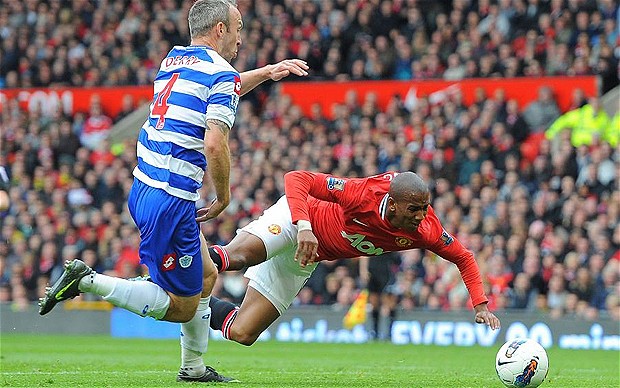
My article this week is about diving.
It is cheating, and divers
should be punished. One high-key player who is very prone to diving is Ashley
Young. He cheated QPR out of a game, and earned Shaun Derry a three match ban
for minimal contact. Then, against his former club, he dived in the penalty
area again, and fooled the referee into giving Manchester United a penalty.
Diving is unacceptable full stop, but against his former club makes it worse.
The club that gave him his big break in the top flight, and he treats them like
this.
There was a person I was talking
to on various message boards during the week on this topic, and he said his
German PE teacher told him that German children were taught to dive whilst
playing football at school. People could say that the ‘foreign art’ of diving
has crept into the English game, but Ashley Young is English. Kevin Davies was
diving earlier in the year, he’s English.
Sergio Busquets is the most
famous player to regularly be considered a diver, but Barcelona play arguably
the best football in the planet, and I can guarantee that Busquets does not
dive every game, and this assumption is based on two, maybe three, high profile
games.
Cristiano Ronaldo, Andy Carroll and Luis Suarez (most games) have all committed the act of diving.
Players don’t have to dive to be
a good player. Look at Robin van Persie, Lionel Messi, Xavi, all brilliant
players, they never feel the need to cheat their team to victory.
My idea is this: punish players who dive or commit dissent by either sending them off in the game if it is seen/heard, or ban them for one or more game afterwards. This would soon get rid of the cheats, as if there is the possibility of them getting sent off, they would be more hesitant to dive to gain an advantage. The amount of games banned for depends on the effects the dive had: Ashley Young’s versus QPR would earn four, one for diving, one for the resulting penalty which was scored, one for getting Derry sent off, and the final game for the eventual Man United victory.
You could say that if Young dives in the European Cup and earns England a penalty which wins us the game, people will be singing his praises. This should not be the case. He should be punished for it. I do not want the rest of the world viewing our country as cheats.
To help the referees out, FIFA need to introduce video technology. There is a rumour that neither the referee nor the linesmen saw Zinedine Zidane’s head butt in the World Cup 2006 final, and was only sent off because the fourth official saw the it in a television replay that was nearby. FIFA denied this, but I believe it to be true.
Follow Callum on twitter: @calriv97. You can find more of Callum's work here.
Thursday, 12 April 2012
Why Refereeing decisions cost teams a lot of money
I’m Callum Rivett, and welcome to my regular blog on The Football Front. First of all, I appreciate every single person who reads this, and I’m only fifteen so any feedback will be extremely helpful and taken into consideration!
Over the Easter weekend and what seems to be continuing into this week, we’ve seen some dreadful refereeing decisions. Whether it be the lack of penalties at White Hart Lane for Norwich (two stonewalls), the two goals that Chelsea scored that shouldn’t have counted or the “foul” on Ashley Young by Shaun Derry on Sunday.
The FA have once again proved how ignorant they are of these continuous mistakes by their officials, upholding Derry’s red card which he received for minimal contact on Young who went down like, well, a Manchester United player in the penalty area. There are people who say the bigger clubs get the big decisions, and I for one could not agree more, with this “penalty” further adding ammunition to their argument.
As I was at Carrow Road on Saturday for the visit of Everton, I shall tell you how bad the officiating was in that game. However, many of you will not have heard or seen these incidents since Match of the Day didn’t show them, because that would be favouring Norwich.
First of all, Leighton Baines should have been sent off. There is no disputing that. I counted that he made five fouls that were all bookable offences, yet he only received a yellow card. The referees today seem scared to send off players who play for the bigger clubs, possibly for the potential backlash from those fans or the respected manager.
Next, we had a clear penalty denied. An Andrew Surman shot was deliberately blocked with his hands by Phil Jagielka who dived in front of the ball. Jagielka was inside the area when he handled it, and could have been booked. This would have made it 2-1 to City just before half-time, and in that position you would have backed us to win the game.
But the most controversial incident was still to come. Steven Pienaar clearly trapped the ball between his legs, even laying on it at one point. This was deemed obstruction by the Norwich players, who stopped and shouted at the ref, who thought it was perfectly acceptable. Everton then scored to put themselves 1-2 up.
When questioned on the decision by Grant Holt, the referee said he “didn’t see it.” But, if you look at replays, you can see the referee a mere six yards away at most.
The FA have two options, either: A) Fine or suspend referees who have continuously made poor decisions in a game, or B) take the money out of football so finishing 9th rather than 10th doesn’t mean an extra £500k. Moving up one position in the Premier League earns you about five hundred thousand pounds, and if you stay in the Premier League you earn considerably more than a Championship team, and rightly so, but if your team gets relegated by one point that a referee cost you, you would be livid. The club would lose out on a lot of money, and you could never see your team in the Premier League again due to an error by the referee.
Now, if the FA decide to drop a referee down to the Championship or League One, they may think it’s all well and good, but what about the two teams in those leagues who get stuck with a terrible ref for a game?
They don’t deserve that.
To end, I would like to say, “have some of that!” to Mark Lawrenson, who continues to write off Grant Holt for an England call up, despite being the second top English goal scorer in the Premier League behind Rooney. 15 goals this season for Holt, and happy birthday to him as well!
=Follow Callum on twitter: @calriv97.
You can find more of Callum's work here.
Subscribe to:
Posts (Atom)

![[Valid Atom 1.0]](valid-atom.png "Validate my Atom 1.0 feed")